

Chonky Spoods Jumping Spider Care Guide

Introduction
Congratulations on your new Chonky Spood and welcome to the wonderful world of jumping spiders!
This care guide covers the basics you need to keep your spider healthy and comfortable. You can always reach out to me through social media (@chonkyspoods on Instagram, Facebook & TikTok) or by email: chonkyspoods@gmail.com if you have further questions or are facing an emergency.
Starter Supplies:
(*starter kit included with every spood order*)
Soft paintbrush - If you ever need to move your spood, a soft paintbrush is gentle and safe. Only use it when you can’t guide them by hand because some spiders can react defensively.
Fine mist spray bottle - A small fine mist bottle to aid with hydration and humidity control.
Plastic tweezers - Occasionally a shed doesn’t come off cleanly. Tweezers let you remove stuck exoskeleton carefully when needed. Also useful for offering food directly without having to reach inside.
Enclosures & Decor
Jumping spiders don’t need large setups to thrive! A small enclosure may seem cruel however these types of spiders can become withdrawn in oversized spaces leading them to hide in their hammocks, or in the case of young jumpers, struggle to find their food. Larger species like Regius and Audax typically won’t need anything larger than a 4x4x8 or 5x5x7. Juveniles (i5-i7) do well in a 3x3x4, 3x3x6 or 4x4x4 enclosure while Subadults-Adults (i8-i12) do well in a 4x4x6, 4x4x8, 5x5x5, or 5x5x7. We recommend a 4x4x8 or 5x5x7 for most adult regius and otiosus. Particularly large and active Phidippus species may enjoy a 6x6x10. Adequate cross ventilation on both sides is critical for oxygen exchange and successful molts. Ventilation on top is preferable as well but avoid top opening lids. Jumping spiders are arboreal and build their hammocks high up in the canopy of their enclosures. Front or side opening designs allow routine care without destroying their hammock and disrupting their safe space.
For substrate, we personally like to use coconut fiber that comes in a roll at the bottom of our enclosures however we do not recommend soil or other organic substrate unless your goal is a bioactive enclosure. You may decorate your enclosure anyway you like, the possibilities are endless! From dollhouse chic to naturalistic, as long as your spood has their basic needs met, they’re not picky about their living situation. They only ask for plenty of things to climb and places to anchor their webs. Wash any new items you buy with hot water, mild dish soap, rinsing for a minimum of 30 seconds with clean, running water. I also like to let new items (especially plastic flowers) air out in a warm room for at least 72HRS. Make sure all decor is free from sharp edges or materials that may transfer onto your spood, like glitter. Porous or painted decorations (paper, wood, etc.) should be sealed with Duraclear or Mod Podge to prevent moisture problems and paint leaching. We also always recommend a hide of some sort for your jumper, particularly one that is hollow from front to back.
Feeding: What to Feed & How Often?
Acceptable feeders include red runner roaches, dubia roaches, house flies, blue bottle flies, blue bottle fly spikes, mealworms, lesser worms, peanut beetle larvae, waxworms (sparingly), silkworms, and hornworms. Match prey to spider size. Always place mealworms and peanut worms in an escape proof dish so they don’t burrow and pupate into beetles, which can injure or sicken spiders. (Disclaimer: you can feed appropriately sized crickets however we do not recommend them as a feeder in general for multiple reasons.) *UNDER NO CIRCUMSTANCES FEED WILD CAUGHT BUGS!*
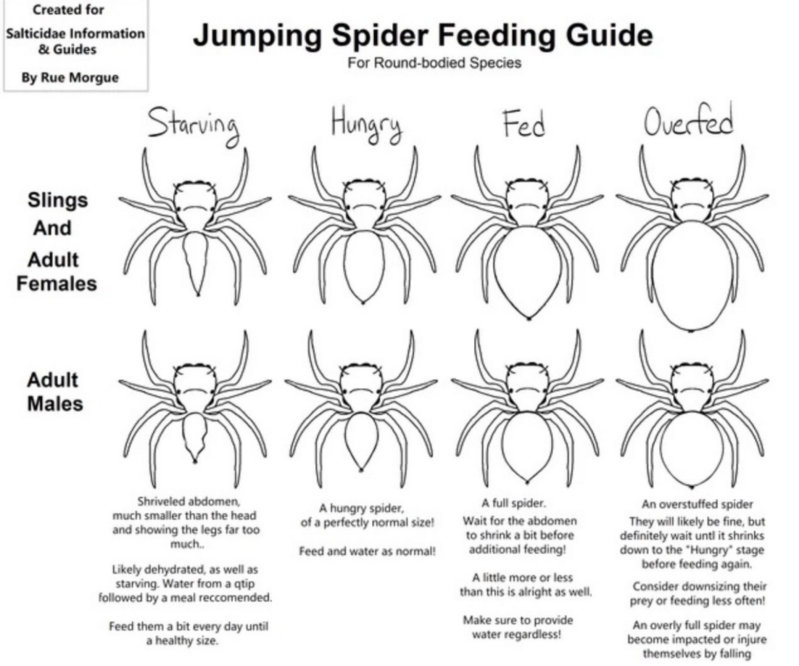
Juveniles (i7): Feed based on abdomen size rather than a fixed schedule. Their abdomen should be 20-30% larger than the carapace. When it begins to look teardrop shaped, offer food. At this size they can be offered house flies, peanut beetle larvae (*larvae only, beetles are not edible), mini/small mealworms, lesser worms, wax moths, xs/small dubia or red runner roaches.
Subadults (i8-i12): Feed based on abdomen size rather than a fixed schedule. Their abdomen should be 20-30% larger than the carapace. When it begins to look teardrop shaped, offer food. At this stage, they can be offered small mealworms, peanut beetle larvae (*larvae only, beetles are not edible), lesser worms, small dubia or red runner roaches, small silkworms, small hornworms, house flies, blue bottle fly spikes, and blue bottle flies.
Adults: Similar to subadults but capable of taking slightly larger prey items. Even though they can handle prey two to three times their size, they will overeat if allowed. Adults usually do well with eating once a week or so however still pay attention to abdomen size.
Many adults may go for weeks without a meal. Males will also have a narrower abdomen once fully mature.
Females laying or guarding eggs may fast for weeks and mature males may go off food for long periods of up to a month before they eat. Continue to offer occasionally; they will resume when ready. Never leave crickets, roaches, or mealworms overnight with your spood unless inside an escape free food dish. They can seriously maim or kill your spider.
Some spiders can be intimidated by larger prey and may refuse a meal, strike & run, or throw their arms up defensively. In this case you can try a different or smaller feeder. Mature males may also become picky, preferring blue bottle flies over all other
feeders.
Where To Purchase Feeders:
Chonky Spoods - peanut beetle larvae
www.rainbowmealworms.com- mealworms (all sizes), blue bottle spikes
www.bestbait.com - blue bottle fly spikes
www.spiderpharm.com - house fly spikes and pupae
www.tcinsects.com - red runner roaches, dubia roaches, silkworms, hornworms, mealworms (all sizes)
Water, Humidity, & Temperature
Humidity varies by species. Phidippus regius and Phidippus otiosus prefer around 50-65% while many other species like P. adumbratus and P. apacheanus thrive near 40-45%, however fluctuations are normal throughout the day. During dry seasons, you may need to mist more often, add damp cotton pieces, or use a humidifier. Avoid spraying directly on tiny spoods and keep droplets small as they can become trapped in large droplets. We recommend using spring or distilled water only. Jumping spiders do best when kept between 68-80°F (24–28 °C) ideally, with a safe overall range of 65-80 °F (19–27 °C). Prolonged cold is not dangerous but slows metabolism and molting, while sustained heat near or above the upper range increases dehydration and mortality risk.
Lighting
Jumpers are visual hunters and sufficient lighting is crucial to their ability to hunt successfully. We recommend full spectrum LED grow lights that can be purchased on Amazon. However *never* leave your spiders in direct sunlight unattended as their enclosure can become rapidly overheated leading to potential death.
Hammocks & Molting
Your spood is one chonky little assassin! Jumping spiders don’t construct webs to catch their prey and instead stalk, pounce, and inject their victims with venom. When your jumper constructs a web, it’s called a hammock. Your jumper will use their comfy, cozy creation to lounge, sleep, and molt. If your spider has lost their appetite, added a few extra layers to their hammock, and locked themselves away, they are most likely preparing to molt. During this time you may up their humidity to 60-70% in order to aid the molting process. Pre-molt can sometimes last up to a month; post-molt, they may remain in their hammock for another few days, possibly a week or two. Please leave your spider be during this critical stage! They are extremely fragile pre and post-molt and the less you interfere, the better. Continue to mist daily and trust that they know what’s best for themselves.
Handling
Before you handle, wash your hands and be sure they are free of all perfumes, lotions, or scented soaps. Handle your jumper on a low, flat surface with a light colored towel or blanket. We normally recommend waiting for your jumper to make their way to the door of their enclosure and then opening it from there to see if they would enjoy a handling session. While they’re incredibly curious, not all spiders enjoy handling and some take longer than others to become acquainted with the feel of human skin.
Jumpers also place anchors or “safety lines” of silk down that trail behind them. We like to try and pin that line to a stable surface each time the spood moves in order to prevent the line from accidentally being pulled which will scare them.
Aging & Life Expectancy
Aging spiders will begin to slow down, eat less, and spend more time in their hammocks. They wiill benefit from a smaller enclosure (4x4x4) with plenty of surfaces to grip as their ability to spin silk disappears with age. The life expectancy of most jumping spiders is 1-3 years with an average of 1.5 across all species. Typically females will live longer than males but this is generally speaking.